
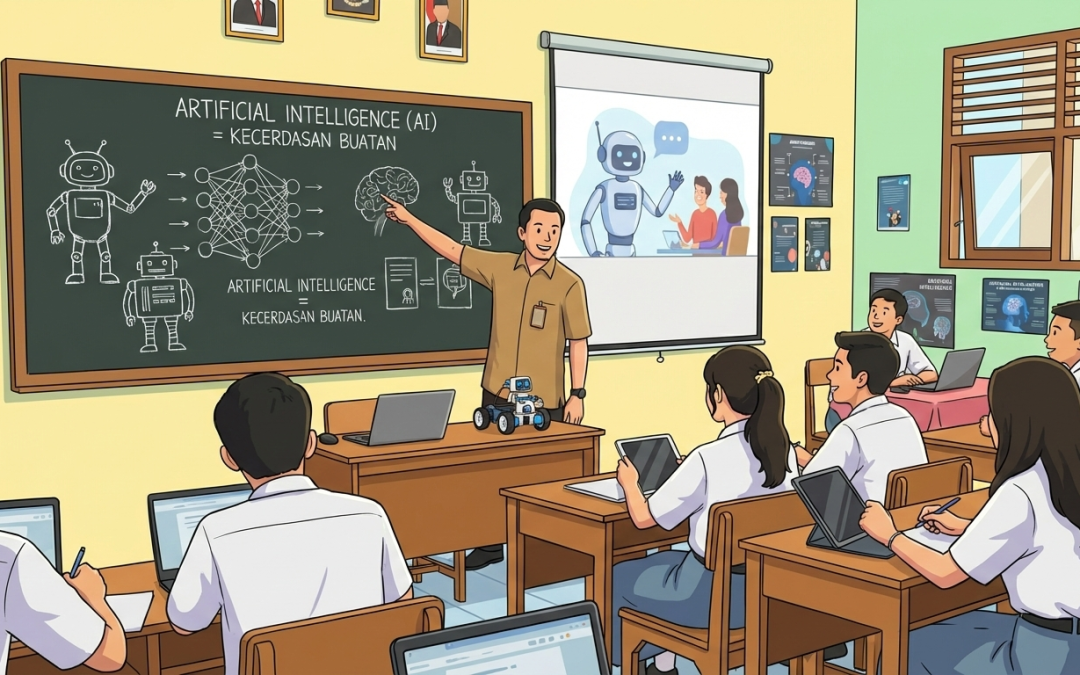
The use of Artificial Intelligence (AI) in mathematics learning has become increasingly widespread, ranging from adaptive practice and automated assessment to virtual tutoring. At the Mathematics Education Study Program of Universitas Alma Ata Yogyakarta, AI is viewed as an innovation that can enhance the quality of learning when used appropriately. However, alongside this potential, there is a critical need to address the ethical aspects and limitations of AI use to ensure that technology functions as a learning support tool rather than a substitute for students’ mathematical thinking processes.
One of the key concerns is the risk of students’ overreliance on AI. When AI is used to provide instant answers, students may lose opportunities to develop reasoning skills, explore strategies, and engage in independent problem solving. AI should function as scaffolding that supports students in understanding processes, not as a machine that merely delivers final results. Teachers continue to play a central role in guiding, challenging, and giving meaning to the mathematics learning process.
Furthermore, the use of AI in mathematics education must take into account issues of fairness and transparency. AI systems operate based on specific algorithms and data sets, which may constrain students’ ways of thinking or overlook diverse problem-solving strategies. Therefore, the Mathematics Education Study Program at Universitas Alma Ata emphasizes the importance of AI literacy for prospective teachers, enabling them to critically evaluate technological outputs while upholding the principles of objectivity and fairness in mathematics assessment.
By understanding the ethical considerations and limitations of AI use, mathematics learning can remain focused on the development of human thinking skills. The Mathematics Education Study Program of Universitas Alma Ata Yogyakarta is committed to preparing mathematics educators who are not only technologically proficient but also pedagogically and ethically aware. AI is positioned as an intelligent and responsible learning partner, ensuring that mathematics remains a primary means of cultivating reasoning, creativity, and learners’ readiness for the future.
Penulis : Rino Richardo