
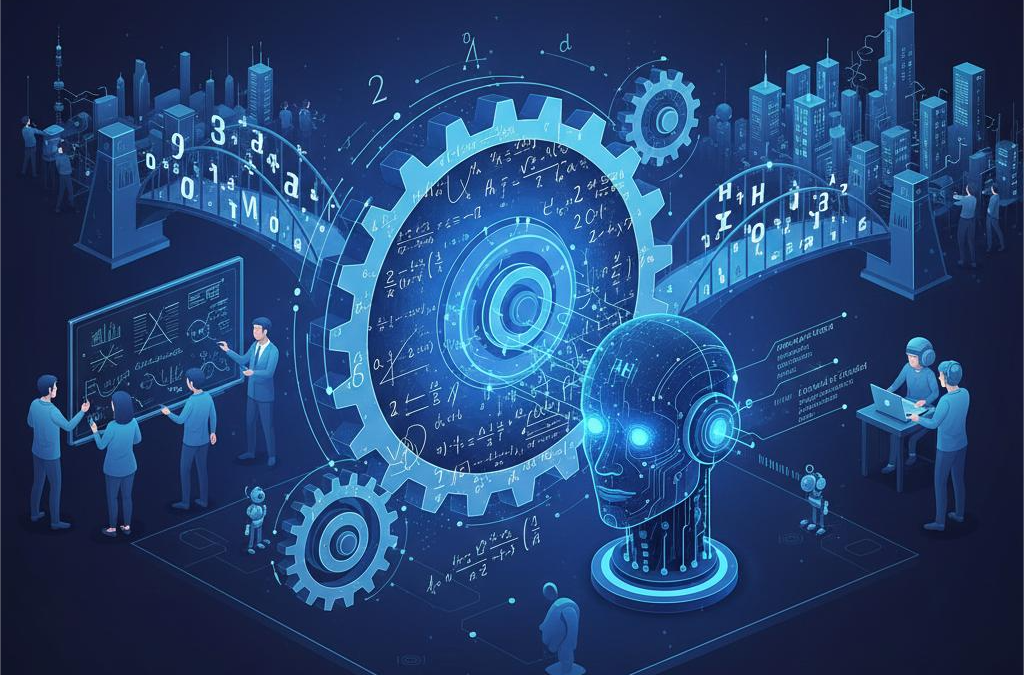
Have you ever wondered why AI can guess your favorite song, recommend TikTok videos that feel “so you,” or even help you with homework? The answer is simple: mathematics.
Behind the sophistication of Artificial Intelligence (AI), mathematics plays a crucial role—often unseen, yet fundamentally decisive.
In today’s AI-driven era, technology is advancing at lightning speed—from chatbots and self-driving vehicles to smart healthcare applications. None of these innovations emerge by chance. Mathematics serves as the core foundation that enables AI to “think,” learn from data, and make decisions. This means that understanding mathematics is no longer just about getting good grades at school; it is about being prepared for the future.
First, mathematics is the primary language of AI.
Algorithms, predictive models, and machine learning systems are all built upon mathematical concepts such as algebra, statistics, and calculus. Without mathematics, AI would be nothing more than an empty program without logic.
Second, statistics and data are the lifeblood of AI.
AI works by identifying patterns within massive amounts of data. This is where statistics plays a vital role—from processing data and analyzing trends to predicting future outcomes. Examples include movie recommendations on Netflix or face recognition features on your smartphone.
Third, mathematics trains critical and logical thinking.
In an era flooded with information and increasingly complex technology, people need systematic thinking rather than simply following trends. Mathematics helps us understand problems, break them down step by step, and find the most effective solutions—skills that are highly valued in AI-driven workplaces.
Fourth, career opportunities rooted in mathematics are expanding rapidly.
Professions such as data analysts, data scientists, AI engineers, and researchers rely heavily on strong mathematical skills. Even in non-technical fields like the digital economy, education, and healthcare, mathematical understanding remains a significant advantage.
Fifth, mathematics is no longer rigid or boring.
In the digital era, mathematics appears in more applied and relatable forms—from social media analysis and game development to the use of AI in education. The way mathematics is learned today is more interactive, creative, and relevant to real life.
In response to the challenges of the AI era, the Mathematics Education Study Program at Universitas Alma Ata offers a learning environment that goes beyond teaching formulas. It emphasizes adaptive thinking aligned with technological development. Students are equipped with pedagogical skills, data literacy, and the ability to integrate technology and AI into mathematics learning. Through contextual and up-to-date approaches, the program prepares future educators and innovators who can bridge mathematics with the needs of the digital generation.
Facing the AI era, mathematics is no longer merely a compulsory subject—it is a life skill. Mathematics empowers individuals not only to use technology, but also to create and control it. With mathematics, people become more adaptive, critical, and competitive in an increasingly intelligent future.
Do not be afraid of mathematics.
Start seeing it as a tool to unlock opportunities, not a barrier. Learn mathematics in a contextual, applied, and AI-relevant way. Because in the era of artificial intelligence, those who master mathematics are the ones who shape the future.